Arches never sleep
A peek at Pompeii
Welcome to Autumn? I hope you all had a restful summer and absorbed some of that all important vitamin D. I personally had a very rare opportunity to go on an extended trip which included the very urban Hong Kong and the very non-urban New Zealand, across which we spent five weeks in total. More on my reflections on engineering and nature in due course. I do have to say, I am totally obsessed with the Kea bird (a large parrot-like creature) which must be one of the cheekiest little buggers out there.
I also did a short trip to Portugal with a friend, a much needed internal recharge (sans family). As with much of Europe, one of my favourite features of the engineering and architecture were the arches.
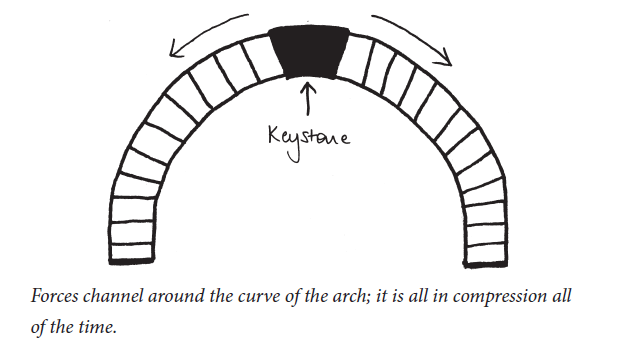
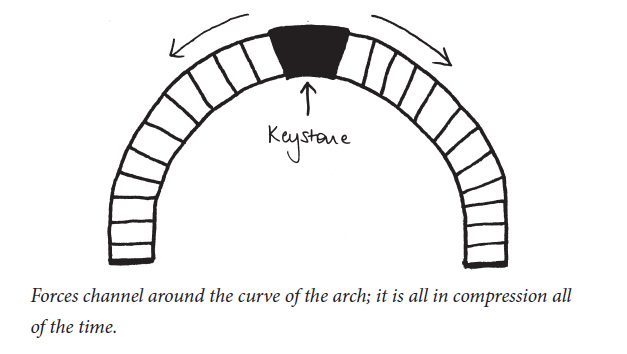
Arches were invented by the Romans (as far as we know), who excelled at constructing them across their empire from brick and stone. Which is why they are ubiquitous across mainland Europe and also in the UK. The way they channel forces is unique, and well suited to those materials. But the pointed arches we often observe in Gothic cathedrals were in fact an Islamic design, originating in Western Asia. Which brings me to one of the most gorgeous sayings I’ve heard, translated from Arabic, which says:
Arches never sleep
The reason, is compression. The force that squashes and pushes materials together. Brick / stone + mortar would crack and fail quite easily if pulled apart — i.e. if tension is applied — but when compressed together, they are incredibly strong. And, most importantly, they could span much larger distances than simple, straight beams.
So, to carry water, people, animals and vehicles, the Romans constructed bridges and viaducts, sometimes multiple stories high, which have lasted millennia.
If you’d like to know more, you can read through till the end, else, enjoy the images!
As always, it really means a huge amount to have you here, and sharing my work with your friends. Thank you.
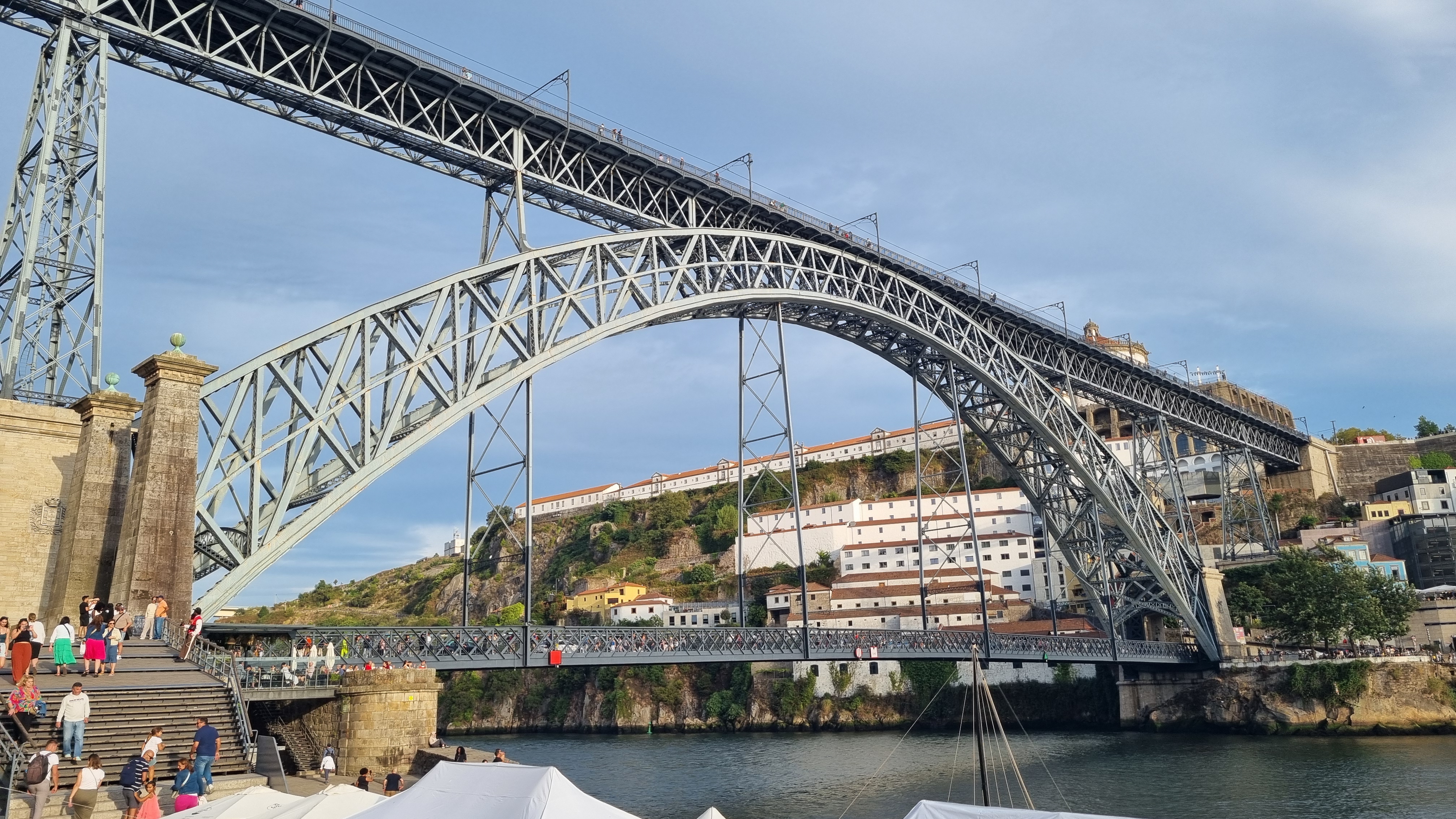
The Luis I bridge in Porto, Portugal
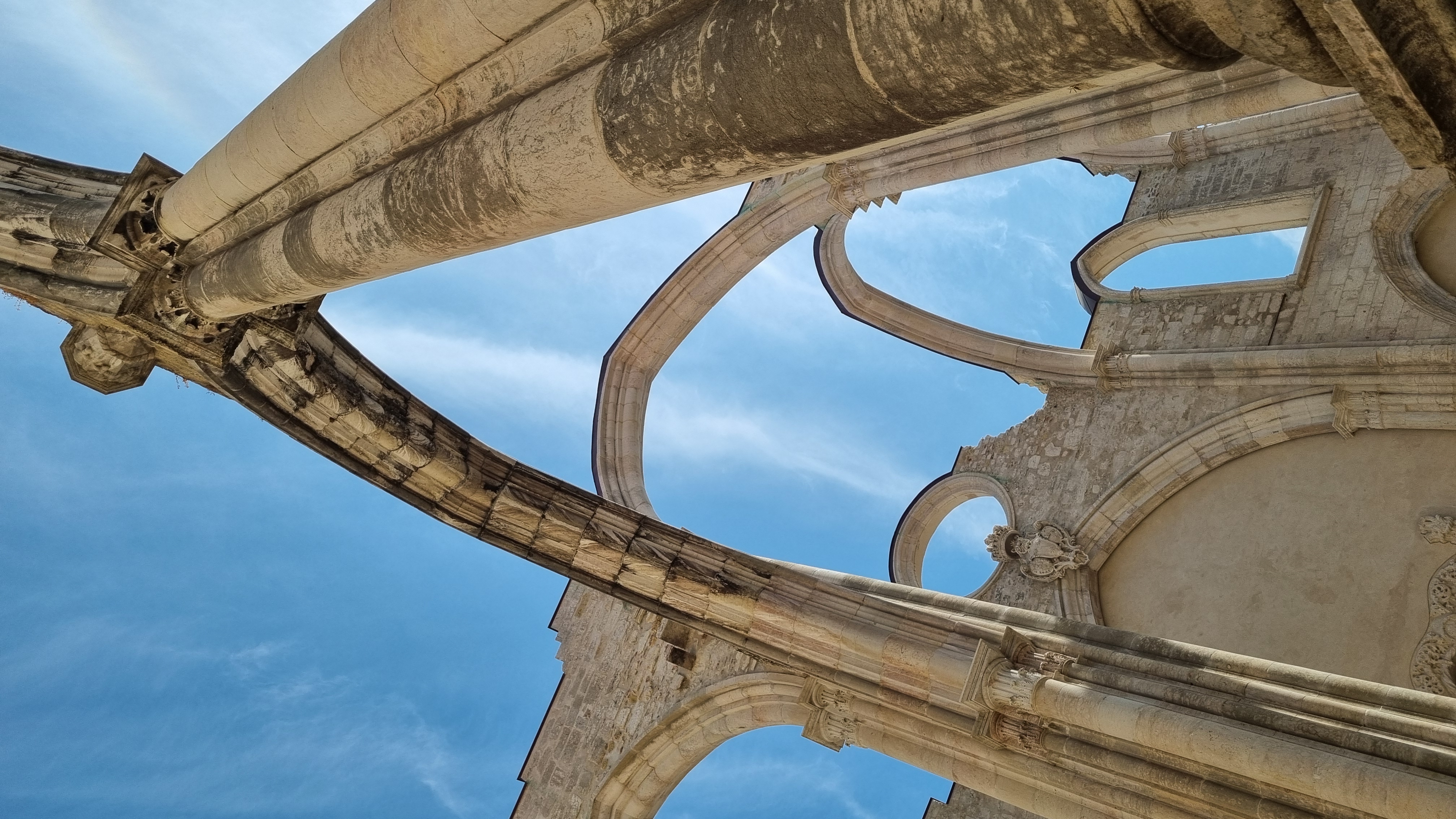
Pointed arch ruins of a former cathedral in Lisbon, Portugal
On Arches, from a trip to Pompeii
The energy and inventiveness of Roman engineering is, for me, a source of wonder and inspiration. So it was with not a little excitement that I took a train south from Naples, along the coast, to one of the most famous archaeological sites in the world. Wearing matching sandals, my husband and I alighted at our destination and put on matching safari hats to keep the scorching summer sun at bay. In great anticipation, we strode towards the ancient ruins of Pompeii.
Along the cobbled streets were shopfronts with counters studded with holes in which conical pots or amphorae were once stored. On the ground was a dramatic floor mosaic of writhing fish and sea creatures. Another showed a ferocious canine and was inscribed with the legend ‘Cave canem’ – ‘Beware of the dog’. Alongside these were well- laid- out homes, like Menander’s (a Greek writer), with its spacious atrium, baths and garden surrounded by a beautifully proportioned colonnaded walkway or peristyle . All these gave a powerful impression of what a glorious, bustling town it must have been in its heyday.
Among the things that most caught my eye, though, were the blood- red bricks. They were everywhere. They peeked surreptitiously from columns on which the decorations that originally hid them from view had crumbled away. They looked proudly on from the walls, where they were arranged in thin layers of three, alternating with sharply contrasting layers of white stone. But my favourite brick- built features were without doubt the arches.
Arches are important building components. They are curved – they are a part of a circle or an ellipse, or even a parabola. They are strong shapes. Take, for example, an egg: if you squeeze an egg in your hand with a uniform grip, you’ll find it nearly impossible to break because the curved shell channels the uniform force of your hand around itself in compression, and the shell is strong in resisting it. To crack the shell, you normally have to use a sharp edge, such as the blade of a knife, on one side, creating a non- uniform load. When you load an arch, the force is channelled around its curved shape, putting all portions of the arch in compression. In ancient times, stone or brick were commonly used building materials – these are great under these squashing loads but not tension loads. The Romans understood both the properties of such materials and the virtues of the arch, and they realised they could bring the two things together in perfect union. Until then, flat beams were used to span distances, whether in bridges or buildings. As we saw earlier, when loaded, beams experience compression in the top and tension in the bottom – and since stone and brick aren’t very strong in tension, the beams the ancients used tended to be large and often unwieldy. This limited the length of the beams’ spans. But by using the high compression resistance of stone in an arch, the Romans could create stronger and larger structures.
Th e brick arches surrounding me had survived millennia, and made me think of the beautiful ancient Arabic saying ‘Arches never sleep.’ They never sleep because their components are continuously in compression, resisting the weight they bear with endless patience. Even when Mount Vesuvius spewed lava over Pompeii, smothering its people and buildings, the arches remained the watchers of the city. They may have been buried, but they never stopped doing their job.